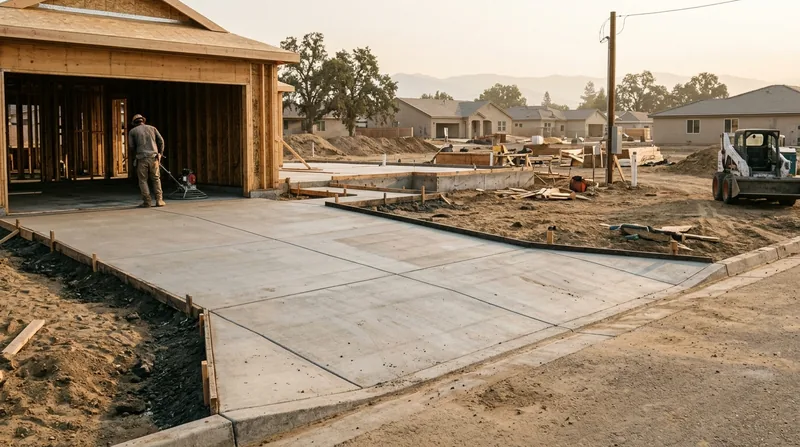




Concrete Slabs & Foundations in Visalia form the backbone of every structure from a new garage to a room addition, a storage shed, or a commercial building footing. Visalia sits on deep alluvial sandy loam and silt laid down by the Kaweah River, with pockets of clay and hardpan that hold water and shift with seasonal changes. The valley's subsidence from groundwater pumping means that subgrade compaction and drainage are not optional, they are essential to prevent settling, cracking, and long-term failure. Summer temperatures regularly exceed 100 degrees Fahrenheit, which accelerates concrete curing and demands careful timing and technique. Whether you are building in the historic Craftsman neighborhoods around Main Street, the post-war ranch tracts of central Visalia, or the newer subdivisions in north and southwest Visalia, a properly engineered slab with correct base preparation and reinforcement will outlast poor work by decades.
Why Proper Slab and Foundation Work Matters in Visalia's San Joaquin Valley Soil
Visalia's alluvial soils are rich for farming but demanding for concrete work. The Kaweah River deposited layers of sand, silt, and clay that vary in bearing capacity and drainage. Unlike coastal or foothill areas, Visalia has no bedrock close to the surface, so every slab depends entirely on the quality of subgrade preparation, compaction, and drainage design. Poor compaction or inadequate base material leads to settling, which cracks the slab, breaks garage door frames, and destabilizes building walls. Visalia's 100-plus-degree summers also mean concrete sets faster than in cooler climates, leaving less time for finishing and proper curing. Getting the foundation right the first time saves tens of thousands in repairs later.
- We compact subgrade in lifts using calibrated equipment to achieve 95 percent of maximum density, the standard for load-bearing slabs.
- We specify base materials (crushed rock, recycled asphalt, or engineered fill) matched to local soil conditions and drainage patterns.
- We place steel reinforcement (rebar or wire mesh) at the mid-depth of the slab to resist tension and control crack width.
- We design concrete thickness and strength for the actual load (vehicle, equipment, or structural weight) and Visalia's soil bearing capacity.
- We control curing in hot weather with shade, misting, and proper timing to prevent flash-set, crazing, and surface checking.
Each of these steps is non-negotiable if the slab is to remain stable and crack-free under Visalia's heat and valley subsidence.
Key info: Visalia homeowners in older neighborhoods often see sidewalks and driveways lifted by valley oak roots or settled by poor base prep. New slabs built with proper depth, reinforcement, and compaction avoid these costly failures. A garage slab that settles even one-quarter inch can jam doors and crack framing. We build to prevent that.
For more on foundation and slab repair after damage occurs, see our Concrete Repair & Resurfacing service page. If you need to lift a settled slab, we also offer Concrete Leveling & Slab Lifting.
How We Build Concrete Slabs and Foundations in Visalia: Our Process
Our slab construction follows a proven sequence designed for Visalia's soil, climate, and building codes. We start with a detailed site assessment to identify soil type, drainage patterns, and any subsurface obstacles. We then excavate to the required depth, remove unsuitable material, and prepare the subgrade. We compact in lifts, verify density with testing, and install base material. Steel reinforcement goes in at mid-depth. We set up forms and control lines, verify elevation and slope, and then place concrete with proper air entrainment and finishing technique. Throughout, we manage curing carefully in Visalia's heat to achieve full strength and a durable surface.
- We survey the site, identify soil type, check for utilities, and review local permit requirements with you.
- We excavate to depth, remove unsuitable soil, and stockpile suitable material for reuse if possible.
- We compact subgrade in 4 to 6 inch lifts using a plate compactor or vibratory roller, testing density as we go.
- We place 4 to 6 inches of base material (crushed rock or recycled asphalt) and compact it to match subgrade density.
- We set forms to grade and slope, then place steel reinforcement (typically number 4 rebar at 18 inch centers, or 6x6 wire mesh).
- We place concrete using proper air entrainment, consolidate it thoroughly, strike off excess, and finish the surface to the specified texture.
- We protect the fresh concrete from sun and wind with shade cloth or plastic, mist if needed, and allow full curing (7 to 14 days depending on thickness and temperature) before loading.
This disciplined approach ensures that your slab remains stable and crack-free for decades, even under Visalia's thermal and subsidence stress.
Local example: A homeowner in north Visalia wanted a 24 by 30 foot garage slab on a lot with sandy loam subgrade and a high water table in winter. We excavated 18 inches, installed a 4 inch layer of recycled asphalt base, compacted to 95 percent density, placed 6 inch thick concrete with number 4 rebar, and misted the slab for 10 days in the 105-degree heat. Two years later, the slab remains flat and crack-free. That outcome depends on doing every step correctly.
If you are planning a new addition or outbuilding, our Garage Floors service covers both new construction and existing garage floor replacement.
Slab and Foundation Methods: Which Approach Works Best for Your Job
| Approach | Description | Best for |
|---|---|---|
| Monolithic Slab | Footing and slab poured as one unit, thickened edges at perimeter for frost protection and structural support. | Garages, sheds, small additions in Visalia where frost depth is shallow and bearing soil is adequate. |
| Stem Wall and Slab | Separate footing dug below frost line, stem wall above grade, slab poured on top with reinforcement tie-down. | Larger buildings, additions requiring structural connection, properties with poor surface soil or high water table. |
| Post-Tensioned Slab | High-strength cables embedded in concrete, tensioned after curing to compress the slab and prevent cracking from settlement or temperature change. | Large slabs over poor soil, properties with significant subsidence risk, commercial buildings where crack control is critical. |
| Floating Slab with Insulation | Slab sits on compacted base with foam insulation underneath, isolated from grade beams or footing, useful for temperature control. | Heated garages, workshops, or spaces where thermal performance matters; less common in Visalia but effective for utility buildings. |
| Thickened Edge Slab | Standard slab with extra thickness (8 to 12 inches) at the perimeter, reinforced with rebar, to support exterior walls or heavy loads. | Building additions, room expansions, or any structure where the slab bears wall weight or concentrated equipment load. |
Your choice depends on the building code, soil bearing capacity, frost depth, water table, and the weight and use of the structure. We assess your site and recommend the method that delivers the longest service life at the best value.
Concrete Slabs and Foundations Cost in Visalia: What to Expect
Concrete slab pricing in Visalia starts at $5 per square foot for a straightforward monolithic slab on well-prepared, suitable subgrade. A typical garage slab (24 by 30 feet, or 720 square feet) at that rate runs approximately $3,600 before permits or site work. However, real jobs rarely land at the bottom of the range. Factors that move the price upward include depth of excavation, poor subgrade requiring removal and replacement, distance to the site affecting concrete truck access, complexity of the shape or reinforcement pattern, and the need for special finishing or curing in extreme heat.
A slab with a high water table or clay subgrade requiring base material import can easily run $6 to $8 per square foot. A post-tensioned slab or a stem-wall-and-slab system for a larger building runs $8 to $12 per square foot or more. Visalia's 100-plus-degree summers also mean we may charge a premium for heat-management curing (shade cloth, misting, extended finishing time) to prevent crazing and early cracking. Getting two to three estimates from fully insured contractors is the smart move, because each crew will assess the site differently and may recommend different approaches based on soil conditions they observe.
For a full breakdown of our pricing and what is included at each level, visit our Pricing page. A free estimate from Visalia Concrete takes 24 hours and comes with no obligation. Call (559) 471-3929 or use our Contact form to schedule.
Real cost example: A homeowner in Farmersville needed a 20 by 40 foot slab for a workshop. The site had sandy loam with scattered clay pockets. Excavation, compaction, and 4 inches of base material brought the job to $6 per square foot. Total for 800 square feet was $4,800. If the site had required 12 inches of base material removal and replacement (common in areas with hardpan), the cost would have jumped to $7 per square foot or $5,600. Always budget for site surprises.
What to Look for When Hiring a Concrete Contractor Near Visalia
Hiring the right contractor is as important as the design itself. You are making a choice that will affect your property for 20, 30, or even 50 years. Start by verifying that any contractor you consider carries general liability insurance and workers compensation coverage. Ask for a certificate of insurance naming you as an additional insured, and confirm that the policy limits are adequate for the job size. A contractor without proper insurance is a liability risk, because if someone is injured on your property or a neighbor's property is damaged, you may be held responsible. Do not hire based on price alone, because the cheapest bid often cuts corners on compaction, base material, or finishing that will haunt you later.
Get at least two or three written estimates that spell out what is included: excavation depth, base material type and thickness, reinforcement type and spacing, concrete strength (psi), finishing method, and curing protocol. Ask for references from recent slab jobs in Visalia or nearby towns (Tulare, Exeter, Porterville, Lindsay) and call them to ask about the quality of the work, whether the contractor finished on time and on budget, and whether the slab has remained flat and crack-free. If the job is in a historic neighborhood (like the Craftsman districts near Main Street or Court Street), check whether your HOA or local historic review board has requirements for the slab or access routes, and make sure the contractor understands those rules. Visalia also requires permits for most new slabs and foundation work, so confirm that the contractor will pull permits, handle inspections, and ensure the work meets current code.
- Verify general liability and workers compensation insurance in writing before work begins.
- Request written estimates from at least two contractors, each detailing excavation, base, reinforcement, concrete spec, and curing plan.
- Call references from similar jobs completed in the last two to three years in Visalia or Tulare County.
- Confirm that the contractor is familiar with Visalia's permit process and will handle inspections on your behalf.
- Ask whether the contractor has experience with Visalia's soil types (sandy loam, clay, hardpan) and can speak to base preparation strategy.
- Understand the payment schedule: typically one-third upfront, one-third mid-job, and one-third upon completion and final inspection.
A professional contractor will answer every question clearly and be willing to explain why they chose a particular approach. If someone is evasive about insurance or won't provide references, walk away.
Ready to move forward? Contact Visalia Concrete for a free, no-obligation estimate. We serve Visalia, Tulare, Hanford, Exeter, Farmersville, Lindsay, Porterville, and surrounding areas. Insured, and experienced in Visalia's soil and climate.
Concrete Slabs & Foundations in Visalia: Pricing Guide
| Service | Price | Details |
|---|---|---|
| Standard monolithic slab | Starting at $5/sq ft | Straightforward excavation, compaction, 4 inch base, 6 inch concrete with rebar, finished surface on suitable subgrade soil |
| Slab with poor subgrade or clay | Starting at $6-$8/sq ft | Excavation deeper than 18 inches, unsuitable soil removal, imported base material, compaction testing, reinforcement placement and curing |
| Stem wall and slab or post-tensioned | Starting at $8-$12/sq ft | Structural footing below frost line, separate stem wall, or high-strength cable tensioning for large spans or poor bearing soil conditions |
| Heat-management curing in Visalia summer | Add 10-15% to base price | Shade cloth, misting, extended finishing time, and curing protection during 100-plus-degree temperatures to prevent crazing and early cracking |
| Estimate | Free | Response within 24 hours at (559) 471-3929, includes site assessment, soil evaluation, and detailed written estimate with no obligation to book |
Indicative pricing, the exact cost depends on square footage, finish, and site access. Free personalized estimate within 24h at (559) 471-3929.


